

Avoid These 3 Mistakes When Lubricating Bearings
Friction is all around us. Without it we would find it very difficult to run, walk, or eve stand on our own two feet. We need friction to drive our cards and fly our airplanes; and we need friction for our motors to drive pumps. But when it comes to our plant machinery, friction is both friend and foe. If part of your job is greasing plant machinery, then you know well the battle against frictional forces that threatens the useful life of rolling element bearings

Friction is all around us. Without it we would find it very difficult to run, walk, or eve stand on our own two feet. We need friction to drive our cards and fly our airplanes; and we need friction for our motors to drive pumps. But when it comes to our plant machinery, friction is both friend and foe. If part of your job is greasing plant machinery, then you know well the battle against frictional forces that threatens the useful life of rolling element bearings
Lubrication of rolling element bearing is one of the most misunderstood and abused tasks in industry. Can it be true that 40% of bearings never live to their engineered life cycle and that bad lubrication practices are the leading cause of this mortality? Bearings depend on grease to reduce friction levels. By avoiding three common mistakes when greasing bearings, you can predict the right time to grease, know how much grease to apply, and be confident in the bearing’s overall health.
Mistake No.1 – Lubricating based on TIME instead of CONDITION
Lubricating a bearing once per week or once per month may seem like a sensible thing to do. After all, performing scheduled maintenance at regular periods is an age-old concept.
Bearings need grease for one reason only; to reduce friction. As long as the lubricant is performing that service well, there should be no need to change it, or add more.
Yet we frequently do, with catastrophic results.
Lubricating a bearing just because your calendar told you “time is up!” is the first mistake. Monitor, measure and trend friction levels with ultrasound to know when it is the right time to grease.
Mistake No.2 – Over and under lubrication
The second mistake we must avoid is adding too much, or not enough grease. Too much grease builds pressure, pushing the rolling elements through the fluid film and against the outer race. The bearing now has to work much harder to push the rolling elements through a mud bog of grease.
The increased friction and pressure from too much grease raises the temperature inside the bearing. Excess heat could decrease the effectiveness of the lubricant causing the oil to separate from the thickener. Not adding enough grease has the same life-shortening effect.
How do we know when just the right amount of grease has been added? By monitoring the friction level with ultrasound as new grease is applied… slowly, one shot at a time. Listen to the bearing and measure the drop in friction as the grease flows in to the bearing. As the decibel level approaches a minimum value and stabilizes pay close attention. Add single shots. Should the decibel level begin to increase slightly, stop! The job is done.

Mistake No.3 – Using a “Listen-Only” ultrasound instrument
Like any job there is a right way and a wrong way to do things. Simply listening to a bearing with an ultrasound device that gives no measurement feedback is a recipe for disaster. The audible feedback alone is too subjective to draw any comparative conclusions. No two people hear the same and there is no way to remember what the bearing sounded like a month ago.
The third mistake is depending solely on subjective ultrasound noise when precise quantifiable data is available. Therefore, always use an ultrasound instrument with digital decibel metering. Better still, use a device that provides multiple condition indicators. Max RMS and Peak dB measurements indicate alarm levels and greasing intervals while Ultrasonic Crest Factor provide insight about the bearing condition in relation to its lubricant. Crest factor helps us differentiate between bearings that need grease and bearings that need to be replaced.
Clear benefits of avoiding the three mistakes
Ultrasound assisted lubrication of plant assets offers significant benefits that calendar-based lubrication cannot. Lubrication serves a primary purpose, which is to create a thin layer of lubricant between rolling and sliding elements that reduces friction. So it makes sense that the best way to determine the lubrication requirement of a machine is to monitor friction levels; not time in service.
Optimizing lubrication of plant machinery with ultrasound will result in a significant reduction in grease consumption. Having an ultrasound program in place will help create a better culture involving cleaner storage practices, sampling, and avoiding mixing greases.
Machines that are properly lubricated require less energy to run. Imagine that reducing the amount of money spent on grease will actually lead to lower energy bills. Machines that consume less electricity run cooler and machines that run cooler have longer life cycles.

Ok, the real reason to optimize bearing lubrication is to extend the life of bearings by making sure they have the right amount of grease, but not too much. When everything is running according to plan lube-techs will spend less time greasing bearings that do not need it. So when counting up the benefits of your ultrasounds program do not forget to add “decreased labor” to the long list.
Finally, by monitoring the condition of your machinery’s lubrication, you are at the same time collecting valuable condition data about the machine itself. Dynamic and static ultrasound data coupled with condition indicators such as Overall RMS, Max RMS, Peak, and Crest Factor are all indicators of bearing health. A practice that does not use this SDT combination is not a real solution when lubricating bearings. Who knew so much good could come from such a simple shift from calendar to condition based maintenance? Now you know.
Darbar Company is Pakistan's leading supplier of Bearings, Timing Belts, and Roller Chains. Our bearings are of the highest quality and require little maintenance. We can guarantee you that our bearings will perform far better than any other on the market, and our prices are very competitive as well.
Original article extracted from Bearing-News magazine
3 Warning Signs of V-Belt Premature Failure
V-belts are the most common type of belt today, and as their name suggests, their cross-sectional shape comes in the form of a “V” and are widely used in industrial, automotive, commercial, agricultural, and home appliance applications. V-belt drive isa popular option to many as it is economical, easy to install and requires no lubrication.
V-belts are the most common type of belt today, and as their name suggests, their cross-sectional shape comes in the form of a “V” and are widely used in industrial, automotive, commercial, agricultural, and home appliance applications. V-belt drive isa popular option to many as it is economical, easy to install and requires no lubrication.
To ensure that your V-Belts have a longer lifespan, it is important that you look out for the following warning signs of premature belt failure:
1. Improper Seating of V-Belt on Sheave
Theincorrect seating of V-belt installation is one of the of the red flags that can cause early damage to your belt. When the seating is too deep, it indicates that the belt section is too small or there is a worn sheave; when theseating is too high, the belt section may be too big.


2. Watch Out For Its Tension
During multiple belt application, having a big difference in the tension of each belt is another early sign of premature belt failure. There is a tension at which belt experiences its optimum service life. Anything above or below its tension results in a decrease in belt life.
3. Seeing Smoke During Operation
If you see burning during the belt drive process, do not panic. Smoking is an indication that there is a slip between the V-Belt and sheave due to either a low belt tension or worn sheave. When sheaves become worn, the sides of the sheave angle start to cup and have a concave appearance and the belt has less area contact with the sheave and slips.

Original article can be read at SLS Blog: http://bit.ly/2liVBKn
Darbar Company provides all kinds of V-Belts and Timing Belts. Contact one of our sales representative to find out which type of belt will work best with your equipment. You can send us your inquiry here
Darbar Company is an authorized distributor of Gates Timing Belts. For more information on what products we sell check our products page here
Three more bearing killers and how to stop them: Part 2
Bearing failure can grind your operations to a halt, resulting in significant lost time and production. Here are the last three of our six common factors that can cause bearings to fail, and what you can do to prevent them.
Bearing failure can grind your operations to a halt, resulting in significant lost time and production. Here are the last three of our six common factors that can cause bearings to fail, and what you can do to prevent them.

#4: Contamination. Even the tiniest of foreign particles can interfere with the lubrication that enables a bearing to function as intended. There are a number of contamination sources, depending on the application. Shop dust, sand, fine metal particles from nearby machining, water and dirt can all interfere with the lubricant that keeps a bearing operating, and can damage the bearing itself. Particles rolling through the bearings and rolling elements will cause premature damage, increasing stress and shortening overall bearing life.
The best protection against contamination is a proper seal, which must be matched with the given application to offer the best possible performance. This information should be available through the bearing manufacturer. Generally, seals should be regularly checked for hardening and cracking around the radial lip; they should be replaced as soon as possible if any visible damage is detected.
Contamination can occur at other points in the bearing lifecycle. Technicians should routinely test oil and grease samples for solid particles. Additionally, when bearings are removed for inspection, technicians should make sure to wash, dry and then coat bearings with the appropriate preservative before packing away, using the proper storage techniques.

#5: Overloading. Bearings are designed and engineered to operate at specified loads, and when pushed beyond those limits, trouble can occur. Overloaded bearings can fracture components, and left unchecked can lead to more serious damage or consequences.
Like overheating, warning signs of overloaded bearings should be monitored constantly. Abnormal noises and vibrations, overheating, the presence of metallic chips in lubricant filters, and overall diminished performance of the bearing can all indicate that a bearing is operating beyond its load limits. The higher the overload, the greater the damage. Other indications include the fatigue, pitting or flaking away of bearing materials, roller fracture, peeling, and potential plastic deformation or subsurface fracture of the rolling elements or raceways.
#6: Corrosion. Bearing applications in harsher industrial environments are more susceptible to corrosive damage caused by rogue fluids or corrosive atmospheres that can interfere with the protective lubricant. Corrosion can lead to wear, which can, in turn, lead to bearing failure

Like overloading, subpar performance due to corrosion can often be detected by increased vibration and noise during operation. Corrosion can be identified by reddish and brown discoloration found on the bearings and raceways—not to be confused with the discoloration caused by overheating. Ensuring the use of proper seals and that those seals are not damaged, is one of the best ways to prevent corrosion on the bearing and raceways. External seals can also be used in more extreme environments if necessary.
Thorough documentation of your bearing installation and maintenance processes can help ensure technicians are being diligent in their monitoring of these common causes of bearing failure. Recordkeeping can help identify trends in bearing performance, forecasted maintenance, and the length of service intervals. Include date, equipment model and serial numbers, bearing assembly and serial number, and the bearing’s manufacturer in your documentation.
In many cases, bearing damage can progress over time. Periodic or continuous condition monitoring (vibration, temperature, lubricant sampling, etc.) can aid equipment and process operators define trends over a bearing lifecycle. Establishing specific operating limits can help define the most appropriate interval for bearing replacement.
Armed with this information, more informed decisions can be made to ensure operations keep your business running smoothly, efficiently and profitably.
Darbar Company is Pakistan's leading wholesale distributor in Power Transmission products. Darbr Company carries over a million types of bearing ranging from Needle, Ball and etc. You can send your specific inquiries by filling out this form
Check out the other three reasons here
Read the original article at BearingTips: http://bit.ly/2lIiyHR
3 Bearing Killers and How To Stop Them: Part 1
Bearing failure can grind your operations to a halt, resulting in significant lost time and production. Here are the first three of six common factors that can cause bearings to fail, and what you can do to prevent them.
Bearing failure can grind your operations to a halt, resulting in significant lost time and production. Here are the first three of six common factors that can cause bearings to fail, and what you can do to prevent them.
No matter the application, the proper functionality of bearings is essential to optimize operations. Whether a bearing is a cylindrical, spherical, ball or roller bearing, its precise design and engineering require special attention to ensure it’s working correctly. Bearing failure means downtime, maintenance and a major blow to operational efficiency—and in many cases, that failure can be easily prevented.
Applications requiring dependable bearing operation are countless but common reasons for bearing failure are fairly narrow. Though improvements in technology, design and user training have helped reduce failure incidents, understanding how and why bearings commonly fail is critical.
Here are the first three of six common reasons for bearing failure and how to make sure they don’t bring operations to a halt:

#1: Improper Handling and Installation. Proper bearing care begins when the bearing first arrives at the application site. From the shipping dock, to storage, to installation, proper handling and care is necessary to ensure the bearing will function as intended.
Even the smallest imperfections can shorten a bearing’s lifespan, and many nicks and scratches occur before the bearing is even put into use. Damage can occur when a bearing is in storage; therefore, if stocking bearings prior to needing them on your plant or shop floor, make sure the proper storage techniques are being followed. Don’t remove the bearing from the manufacturer’s original packaging unless absolutely necessary; if it must be removed, store in anticorrosive wrapping, and apply the appropriate preservatives to the bearing first.
When ready to install, cleanliness is critical. Technicians should perform the work in as clean an environment as possible, using clean tools, and should take care not to remove any of the preservative coating. Carelessness is the most common cause of damage to the bearing throughout the installation process. Poor handling while removing the outer races from housings or wheel hubs, for instance, can leave burrs or high spots in outer race seats. Tools can inadvertently gouge housing seats, leaving imperfections that can increase rolling contact stress, limit fatigue life or fracture machine components in the worst cases—all the more reason to ensure your installation processes are conducted with care and precision.

#2: Improper Lubrication. Lubrication is the lifeblood of proper bearing operation, and it is dependent on several variables in any given application.
Most bearing manufacturers and suppliers will recommend a specific lubricant type, grade, supply system, viscosity and additives for the application. They will also provide the amounts of lubricant that should be used and how often it should be changed or replenished. More application-specific recommendations and details including loading, speeds and sealing are often included as well.
Just like the bearings themselves, lubricants must be stored properly. Shelf life, temperature, filtration and other precautions will again be available via your bearing/lubricant supplier.
Technicians should adhere closely to these recommendations—bearing compatibility and performance depend on it. Underfilling and overfilling, mixing and matching lubricants, and changing lubrication at irregular intervals can all result in significant damage that can bring your operations to a standstill.

#3: Overheating. A primary function of proper lubrication is to prevent the overheating of bearings and associated components. Overheating can lead to damage and ultimately breakdown for a variety of reasons related to the lubricant. Higher temperatures can be caused by ambient temperatures, process temperatures, and severe operating conditions that can increase rolling contact friction. Likewise, lower ambient temperatures can have a negative effect—lubricant viscosity increases at lower temperatures and can cause improper flow and therefore compromise protective benefits. Your lubricant supplier can provide the ideal operating temperature change.
Technicians can and should do more than simply follow supplier instructions to ensure lubricants are performing properly and keeping their bearings at the appropriate temperatures. Be vigilant about monitoring bearings for heat-related trouble signs that can impact lubrication and ultimately the bearing itself. In order of severity, these symptoms include:
- Bearing discoloration. This will occur as a result of metal-to-metal contact, a sure sign of a lubrication issue. Look for gold and blue discoloration on races and rollers; lubricant staining is common in mild cases, while the metal itself may be discolored by excessive heat in worse cases.
- Peeling and scoring. Marks cut into the metal or peeling metal indicate a more severe lubrication/heat issue and should be addressed immediately.
- Localized scoring. This occurs due to the breakdown of the lubricating film which causes direct contact between components. Address immediately.
- Cumulative wear. High localized heat can alter the geometry of the bearing itself, resulting in a locked-up bearing that can cause significant additional damage.
Read the original article at: http://bit.ly/2m8jZgo
Follow bearing tips to get the latest tips on bearings
Demystifying Bearing Fit Practices
If you enjoy ambiguity and uncertainty, there are few better places to start than fitting a small ball bearing with tight clearance. Just to keep things simple, I’ll use Koyo’s (JTEKT) main Ball & Roller Bearings catalog for the technical information. All full-size bearing catalogs will have the same information.
The place to start when determining fit is with clearance. When dealing with ball bearings, the term “clearance” always means radial internal clearance, whereas when we preload tapered bearings, we are usually talking about axialpreload/endplay (Fig. 1). For your reference, axial clearance is around 10x the distance of radial clearance.

Let’s just walk through a quick example with my favorite bearing, i.e. — 6205. When ordering these you must know what clearance you are ordering; this will usually be indicated somewhere in the title. Even though there is a “normal” clearance designated with CN, C3 is by far the most common clearance.
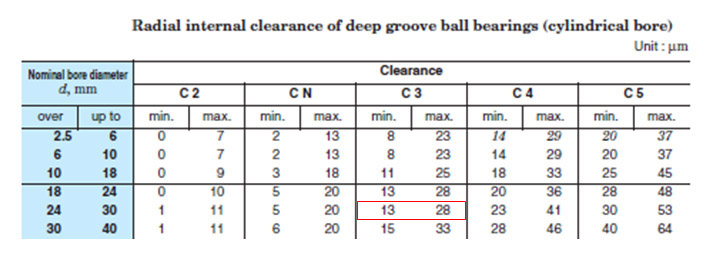
k great — you now have a C3 6205; what does that mean? Fortunately, ISO ball bearings are very standardized, so you can find clearance tables similar to Table 1 just about anywhere online or in any catalog, and it will be the same for any brand. Since a 6205 has a 25 mm bore (multiply the last digit by 5), under the C3 column you see that we have a clearance range of 13 – 28 microns (µm). This is basically how much room we have to work with. Unlike tapers, we do not want to preload a ball bearing. There are a few situations with lightly loaded bearings where you can add a light axial preload via spring or similar method; but we will never try and radially preload a ball bearing.
For most normal ball bearing applications, you will want an interference fit on one ring and leave the other ring loose or leave the other ring as a loose fit (aka clearance fit). There are three reasons for this: 1) there is not enough internal clearance in the bearing to press both rings; 2) one slip ring prevents over-constraining the bearing system; and 3) without special tooling you will need to press one of the rings through the bearing, which is a huge mistake (e.g., pressing the bearing into the housing with the shaft). You will damage the bearing by doing this. If you need to constrain the loose ring, you need a mechanical retainer such as a snap ring.
When possible, the rotating ring should have the interference fit. The only reason for this is that the turning ring is mostly likely to try to walk around the shaft due to inertial effects. Some light walking or creeping is harmless as long as you aren’t moving material or creating heat. For our 6205 example, let’s say we are pressing onto a rotating shaft, which carries a stationary load.

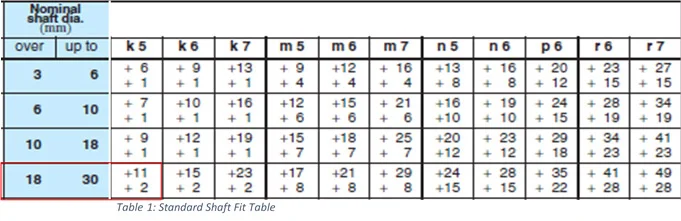
Table 2 gives us a recommendation, but we still need to do more work. If we are working with a normal load (6-12 percent of the dynamic load rating), a k5 shaft fit is recommended. Usually hidden somewhere in the appendices there will be standard shaft and housing fit tables. As shown in Table 3, our 25 mm shaft diameter has a k5 fit of +2 / + 11 µm. These dimensions are applied to the diameter class of the bearing (not the average diameter). For instance, a 6205 has an inner ring diameter tolerance of -10 µm, leaving the true average around 24.995 mm, rather than 25.0. Fit tolerances are applied to 25.0 mm. For our 6205 the recommended shaft is 25 +2/+11. Sometimes unilateral tolerances can make for easy proofing (rather than 25.002/25.011); your choice.
You may quickly realize that you have been handed a 9-micrometer tolerance to work with. This is tighter than the bearing tolerance that you are buying and, for most places, unrealistic. A k7 or k8 is the more likely reality for most places. You can see that all of the fits in the k series have a minimum press of 2 µm. I will often use 5 µm as a minimum threshold for a “press fit,” but I’m not going to argue about 3 µm. Where the hand-wringing starts is when we look at the stack-up for these fits. Again recalling that our inner ring has a -10 µm tolerance, a k5 leaves with a fit range up to 21-µm interference. All things considered, the residual clearance ranges from 11 µm interference to 26 µm clearance.
But what about the clearance?
Ok, there is a slight caveat; you can have a little radial preload before you fall off the edge. The reason I recommend not trying to design this in is, as you can see, trying to avoid any chance of preload would leave you with a very loose shaft on the other end; that will create problems for you. As we are threading this needle, the small amount of potential preload at the limits can be tolerated (more so than an excessively loose shaft).
Now let’s see how this looks with a more realistic range. For me, I would target about +5/+30 for this application. That puts our effective clearance at 16 µm interference to 24 µm clearance. If you are looking for a rule of thumb for how far you can play this game, I like to have my clearance range about 2x the interference range. Statistically, this will rarely get you into the fringes of your clearance window. My +5/+30 would be a few microns on the tight side, but with a bearing that has a healthy life margin, there is nothing to worry about. If I were pushing the life limits of the bearing, I might back down to +2/+27. Many bearing suppliers will agree with this approach; some get nervous when relying on statistics. This is just the reality of bearing fits.
The housing fits are quite a bit easier. Start with a line to line fit and let your tolerance decide the upper end. So for my 6205 with a 52 mm outer diameter I am going to set my lower housing diameter at 52 and the upper end is going to be whatever I can hold. Easy breezy.
Follow these simple rules and your fits will be perfect:
- Know your bearing clearance, dimensions and tolerances up front.
- Press fit one ring (preferably the turning ring) and slip fit the other. Follow the tables for guides, but also double-check your stacks to make sure you aren’t running more than ~ 30% into potential preload.
- Start line to line on the housing. Too loose of a housing can create alignment and/or noise problems. Sometimes too close of a housing fit can be difficult to install. Adding a little oil to the outer ring is common practice. Leave opening up the diameter as a last resort.
Read the original article here: http://bit.ly/2mdH8gz
Power Transmission Engineering is a great blog to follow to keep up with industry insights!